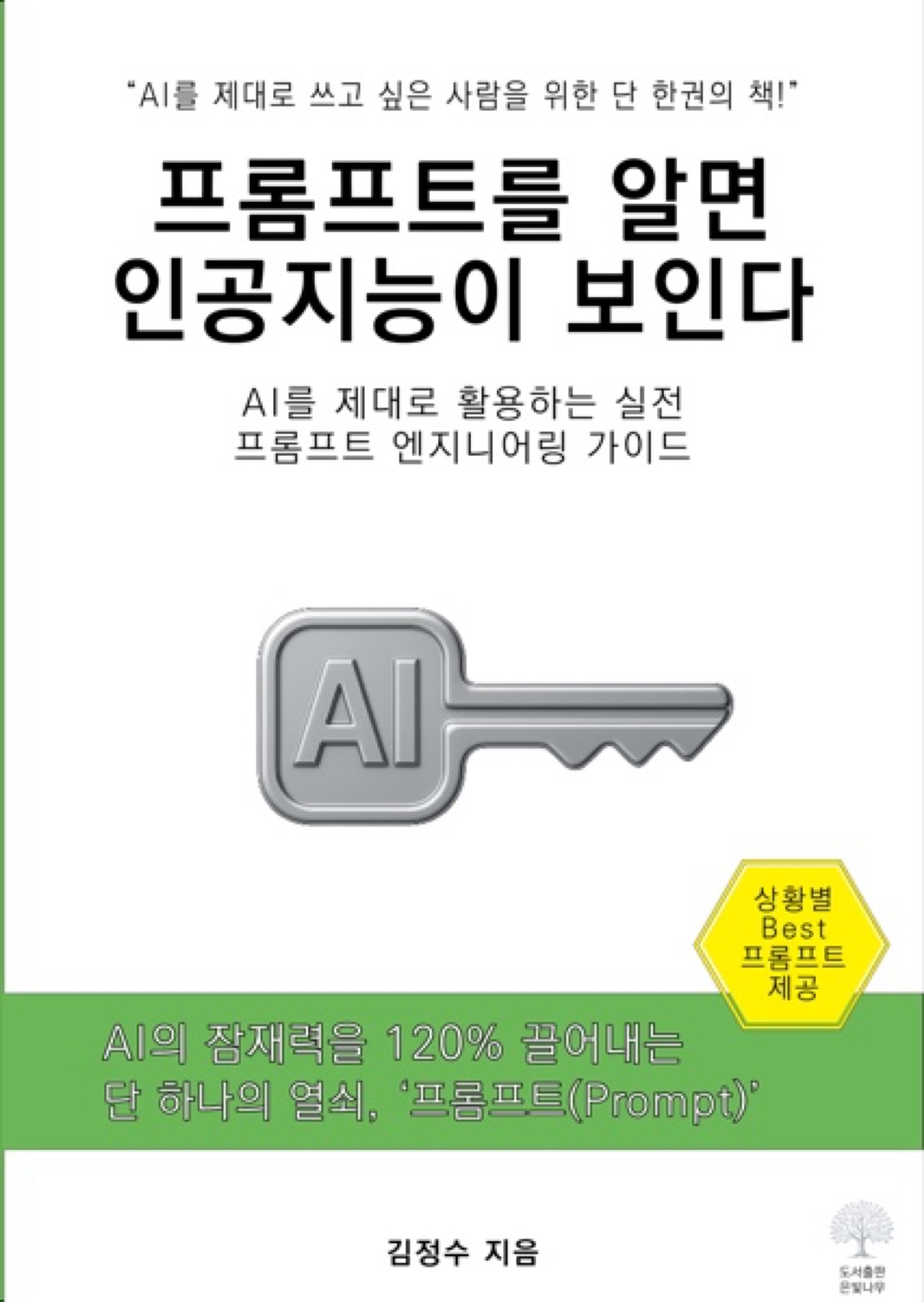
The book
Understanding AI Through Prompts (Korean title 『프롬프트를 알면 인공지능이 보인다』) was published by Silver Tree Books on 20 July 2025. It is the first volume of the publisher’s Silver Tree AI Trilogy, in which three books by Jungsoo Kim run from using AI, to building it, to the principles underneath.
The book is written for anyone who wants to actually use AI. It starts from a single premise: an AI’s answer never rises above the quality of the question. What changed after ChatGPT was not that machines began to understand language, but that the quality of a person’s instruction became the ceiling on what the machine could return. The book treats prompting as a language that can be learned systematically, rather than a knack a person either has or does not.
How it is organized
The core of the book is seven laws of prompting. Each is presented with a Bad-to-Good rewrite and a reusable template.
- Clarity. Say precisely what is wanted.
- Persona. Give the model a role to answer from.
- Context. Supply the background the model cannot know.
- Format. Specify the shape of the output.
- Few-shot. Show examples of the answer wanted.
- Chain of thought. Ask for the reasoning, not only the result.
- Positive framing. State what to do rather than what to avoid.
Field chapters follow the laws and apply them to writing, business and marketing, image generation, study, and everyday use. The closing part covers building a personal prompt library, troubleshooting prompts that fail, and what comes next. An appendix carries 100 ready prompts, an evaluation checklist, a tool guide, and a glossary.
Contents
- Preface. Your questions become your future.
- Chapter 1. A new language for talking to machines.
- Part 1, First steps (chapters 2–4). Good prompts and bad, how a large language model thinks, choosing a tool.
- Part 2, The seven laws (chapters 5–11). Clarity, persona, context, format, few-shot, chain of thought, positive framing.
- Part 3, In the field (chapters 12–16). Writing, business and marketing, images, study, daily life.
- Part 4, Growing with AI (chapters 17–19). Building a prompt library, troubleshooting, what comes next.
- Epilogue and appendix. 100 best prompts, evaluation checklist, tool guide, glossary.
Why principles rather than a manual
The book deliberately teaches principles instead of one product’s interface. Interfaces change with every model release. The seven laws do not, because they describe how a request has to be shaped for any language model to answer it well. That choice is what lets the book stay useful after the next release.
An AI’s answer never rises above the quality of the question.
Bibliographic details
- Publisher: Silver Tree Books
- Published: 20 July 2025
- ISBN: 979-11-993543-1-9
- Extent: 275 pages, 176 × 248 mm
- Language: Korean
- Series: Silver Tree AI Trilogy, Part 1 (Using AI)
The book page on this site carries the full description. The book is sold through YES24.
About the trilogy
Part 2, The Local LLM Bible, followed in January 2026 and covers self-hosted models for organizations. Part 3, Introduction to Artificial Intelligence, a course text on how AI works, was published on 3 August 2026, completing the trilogy. Taken together the three books are one design: how to use AI, how to build it, and how it works.