The paper
“The Dynamic Causal Effects of Corporate AI Adoption on Profitability and Market Value: An Empirical Analysis of KOSDAQ Panel Data” was published in March 2026 in a KCI-indexed journal, Vol. 6, No. 2, pp. 135–154. Jungsoo Kim (Professor, Midwest University) is first author. Bongkee Baek (Professor, Soongsil University) is second author. The paper was submitted on 27 February 2026 and accepted on 24 March 2026.
The question
Companies are adopting AI at speed, and the usual justification is that it will pay for itself. The paper asks whether it does, and on what timeline. It separates two things that are often conflated: the effect of adoption on a firm’s accounting profitability, and the effect on how the market values the firm.
Data and method
- Sample: 922 KOSDAQ-listed firms, 7,376 firm-year observations, 2018–2025.
- Identification of adoption: the timing of each firm’s AI adoption was identified through a multi-step, contextually validated text analysis of DART business reports. A four-step verification excludes AI-washing, meaning mentions of AI without externally corroborated deployment.
- Identification strategy: a two-way fixed effects (TWFE) model, with propensity score matching (PSM) to control for endogeneity in who adopts.
- Outcomes: operating profit margin (OPM) and return on assets (ROA) for profitability, and Tobin’s Q for market value.
What it finds
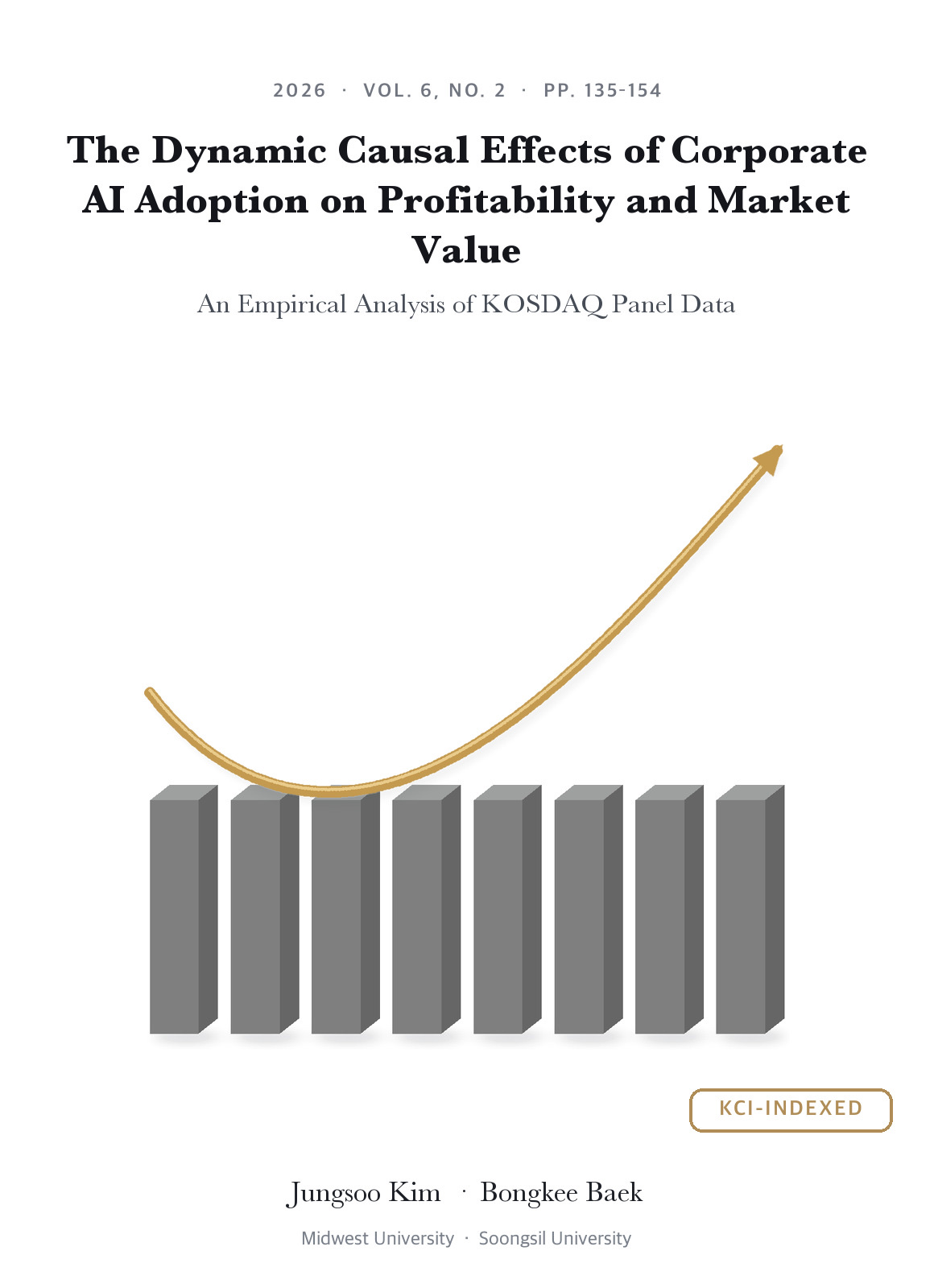
- Adopting AI costs money before it makes money. Operating profit margin falls significantly in the short run. The pattern is consistent with the J-curve of transition costs: process redesign, capability buildup, retraining, and integration land before any return does.
- ROA shows no statistically significant change. Income compression and asset expansion offset each other during the early phase of adoption.
- On average, market value does not move. Across all firms the effect on Tobin’s Q is not significant.
- In ICT, the market pays for it. Among ICT firms Tobin’s Q rises significantly after adoption. Investors price AI adoption as a future growth option, selectively, in an industry with strong data infrastructure, a digitally ready workforce, and the capacity to absorb the technology.
AI adoption lowers short-run profitability and raises market value in ICT. The market prices it as a growth option, not as this year’s earnings.
Why it matters
The result is that AI is not a uniform treatment. The same adoption produces different value depending on the complementary assets a firm already holds and the ecosystem it operates in. For managers the implication is to budget for the J-curve rather than expect a first-year return. For investors it is that the growth-option reading holds where the complementary assets exist, and not elsewhere. For policy it suggests that AI diffusion programs work through industry structure, not only through the technology.
Keywords
Artificial Intelligence, Financial Performance, Corporate Value, KOSDAQ, Panel Data, Fixed Effects Model, Complementary Assets, J-Curve, General Purpose Technology.
Where to read it
The paper page on this site carries the abstract, key findings, and bibliographic details. The full text is available through KCI.